
A food factory featuring a riverside promenade, a heritage terrace block, and a central plaza tailored for public events and community activities is an unprecedented addition to Singapore’s industrial environment. This innovative concept is being introduced by CapitaLand Development (CLD) in the Kallang precinct with their forthcoming integrated food hub, Gourmet Xchange.
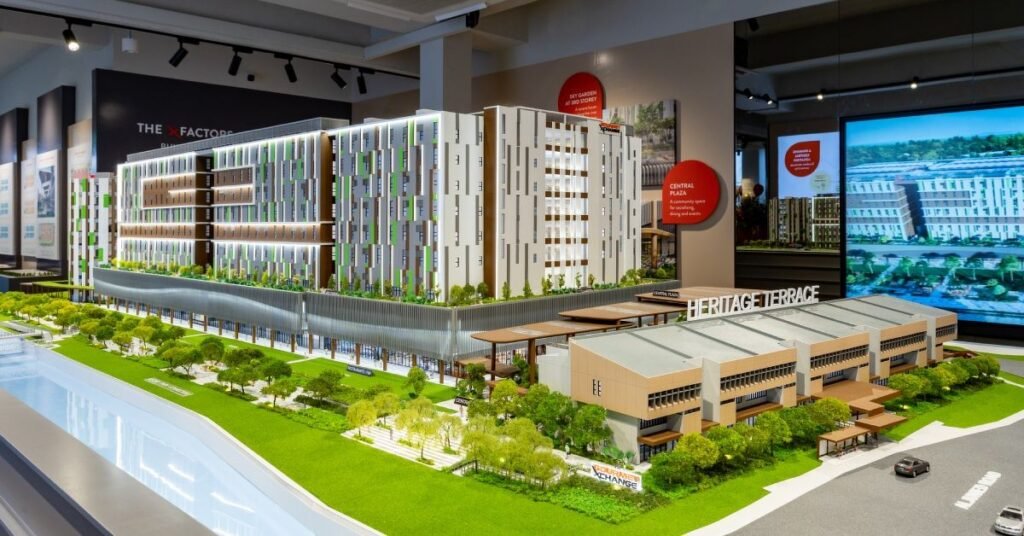
Located at 1 Kallang Way, this expansive development will comprise 272 units, including a nine-storey ramp-up food production facility and a three-storey heritage terrace block—an adaptive reuse of an existing 1980s flatted factory on the premises. CLD envisions Gourmet Xchange as a “food hub 2.0,” merging production facilities with dining options, community spaces, architectural heritage, and riverfront engagement.
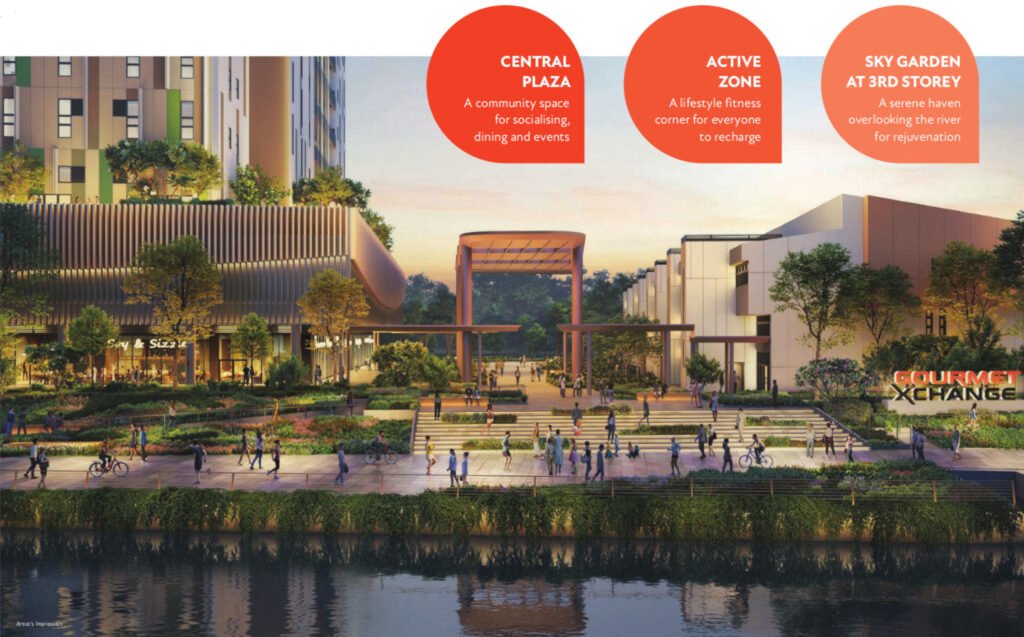
Ronald Tay, CEO of CapitaLand Development (Singapore), emphasizes that “what we’re constructing deviates from traditional industrial buildings.” He asserts that it is designed to be future-ready while addressing the requirements of both tenants and the broader community.
Sales bookings for strata units are set to commence on March 13. CLD aims to provide diverse unit types to cater to various business models within the food industry value chain encompassing production spaces, storage solutions, distribution networks, F&B outlets, food tech entities, and laboratories.
Starting prices for smaller food production units range from $2.3 million for sizes between 295 to 393 sq m (3,175 to 4,230 sq ft), while larger units of 570 to 758 sq m (6,135 to 8,159 sq ft) begin at $6 million. Buyers can expect vacant possession by 2029 and legal completion by 2032.
Unit Type Overview:
- Heritage Terrace: Restaurant / Business (Food): 8 stacks; Area: 598-753 sq m (6,437-8,105 sq ft)
- Standard Unit: Business (Food): 210 units; Area: 295-393 sq m (3,175-4,230 sq ft)
- Deluxe Unit: Business (Food): 45 units; Area: 570-758 sq m (6,135-8,159 sq ft)
- Restaurant: 2 units; Area: 655-669 sq m (7,050-7,201 sq ft)
- Industrial Canteen: 1 unit; Area: 399 sq m (4,295 sq ft)
- Food Kiosk: 6 units; Area: 34-40 sq m (366-431 sq ft)
Catherine He from Colliers Singapore remarks that this project has been thoughtfully designed to serve regional-scale operators as well as central kitchens. She notes that “the potential mix of occupiers is appealing due to sustained long-term demand for Singapore’s food manufacturing and distribution,” contingent upon proactive management curating a balanced tenant base.
Strategic Location with a City Fringe Location

For food businesses reliant on proximity for freshness and logistics efficiency—most currently located in peripheral industrial estates such as Mandai or Jurong—Gourmet Xchange represents a strategic shift. Positioned in Kallang with access via four major expressways and within walking distance from three MRT stations makes it approximately a twenty-minute drive from key areas like the CBD or Changi Airport—regions characterized by high restaurant density and significant F&B expenditure.
Tay describes Gourmet Xchange as akin to a “CBD of food hubs,” asserting that “Kallang offers unparalleled centrality.” The site’s advantageous location enhances delivery speed while ensuring quality preservation during transit—a critical factor for local F&B suppliers.
According to Wong Xian Yang from Cushman & Wakefield (C&W), operators particularly seek Central Region kitchen spaces due to cost-effectiveness associated with delivery efficiencies amid rising retail rents pushing F&B businesses toward central kitchen models.
Current monthly rental rates for central food factories hover between $3.00-$4.00 psf compared to $2.00-$2.60 psf in suburban locales based on C&W data analysis. Additionally, supply remains limited since many sites lack suitability for conversion into food factories with most land already developed under current zoning regulations.
Oliver Siah from Fraxtor praises Gourmet Xchange’s adjacency to substantial population catchments noting its twenty-minute access drive from multiple commercial hubs across Singapore—including Northpoint City and Jewel Changi Airport—highlighting its appeal among prospective tenants seeking operational advantages tied directly to workforce accessibility given its proximity near residential estates.
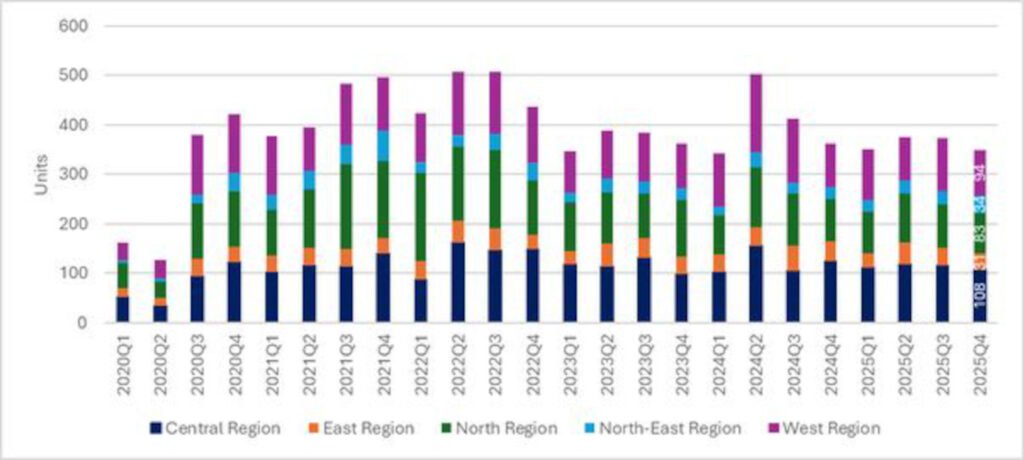
Multi-user factories Sales Volume
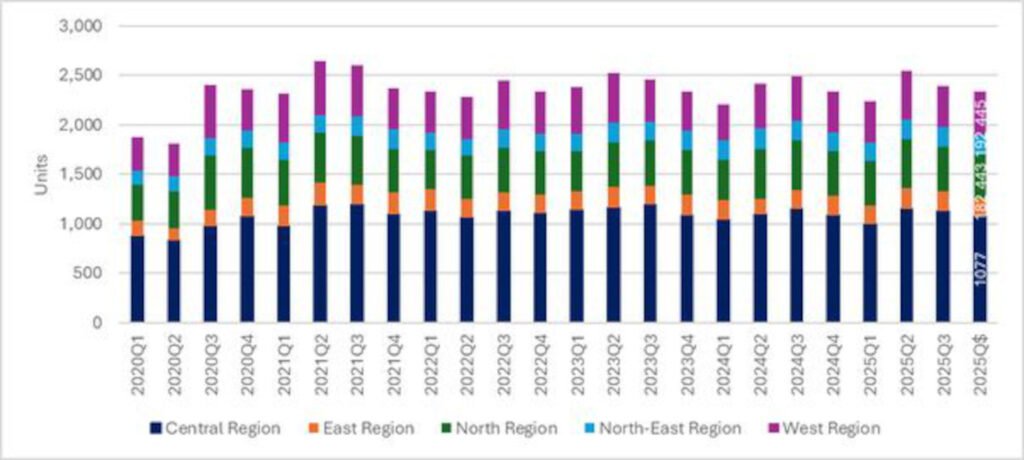
Multi-user factories Rental Volume
Enhanced Operational Flexibility
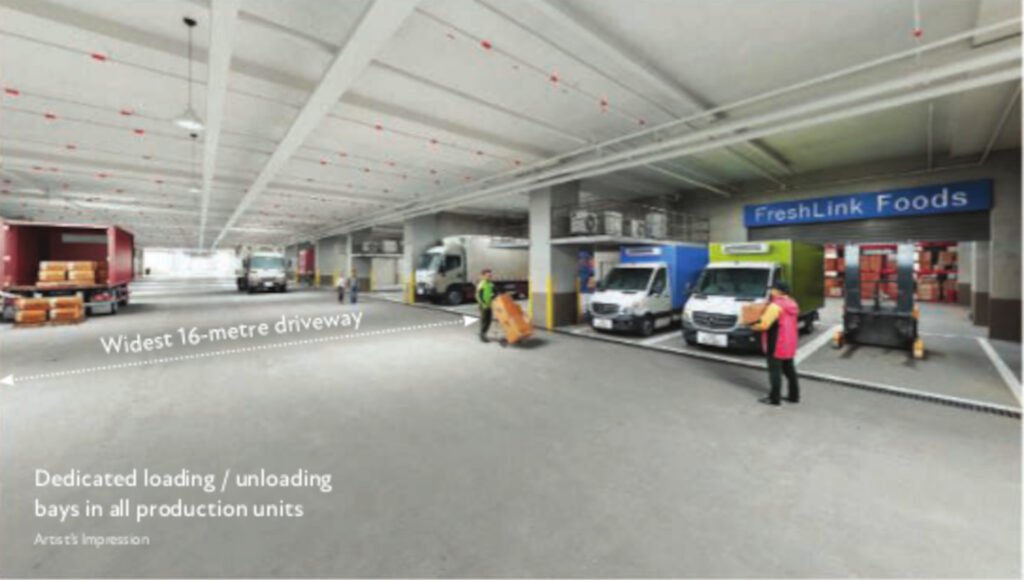
Gourmet Xchange stands as Singapore’s largest food facility with strata titles, boasting extensive infrastructure that includes rare large contiguous spaces ranging from 3,000 to 7,000 sq ft—more than double the typical size of small industrial units. This sizing allows burgeoning businesses to expand within the same location and provides ample space for automation equipment and layout variations. CLD’s Tay notes, “Many companies seek the capacity to grow. We recognized this need.”
A significant attribute of the facility is its ramp access for 40-foot container trucks on the first three floors of the main building, enabling direct parking for loading and unloading at each unit. For units located on higher floors, deliveries can be accommodated via a service lift designed for 40-foot trucks. Additionally, the development features driveways that are 16 meters wide and ceiling heights reaching up to 7 meters.
Siah from Fraxtor envisions creating an integrated ecosystem of food industry players under one roof. He suggests that food delivery platforms could streamline pick-ups from several central kitchens in one journey, thereby reducing delivery costs and emissions.
Each production unit within Gourmet Xchange benefits from dedicated loading and unloading bays designed for 24-foot rigid-frame trucks.
According to PropNex, the clustering or integration of related businesses can foster collaboration among tenants, enhance operational efficiencies, and provide mutual advantages.
The variety of unit types available also allows developers and owners to respond to different demands within the food production and logistics sectors as well as consumer-facing F&B outlets, asserts Kelvin Fong, CEO of PropNex. Furthermore, these versatile and scalable spaces correspond with Singapore’s changing food industry landscape—where there is a rising need for flexible environments capable of supporting various operations. “For example,” Fong elaborates, “an operator may establish a production site, an R&D center, a central kitchen, and an F&B outlet all within one development.”
Food Hub with a Heritage Feel
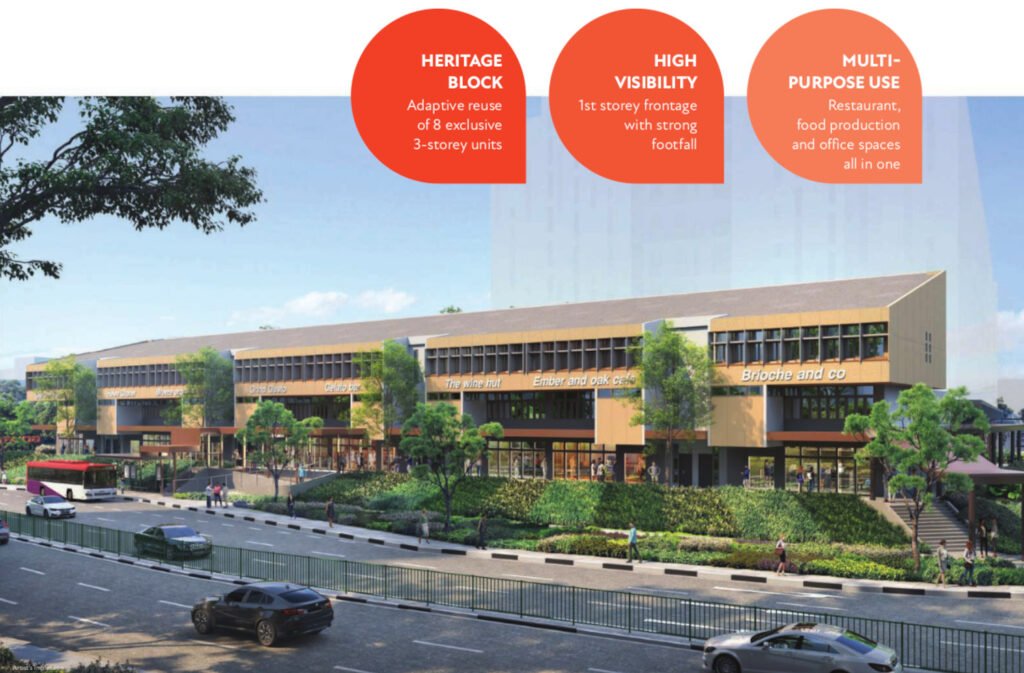
SRI’s head of research and data analytics, Mohan Sandrasegeran, believes that adaptive reuse can improve a development’s identity and character by introducing “architectural diversity and a sense of place that is often lacking in traditional industrial estates.”
For tenants—especially those involved in food innovation, foodtech, and similar fields—such environments offer both operational efficiency and branding advantages. Sandrasegeran notes that “the retained industrial aesthetic can communicate authenticity and sustainability values that appeal to an increasingly ESG-aware audience of businesses and consumers.”
CLD recognizes the potential for value generation through adaptive reuse. Tay expresses this vision: “Our aim is to harmoniously integrate the original flatted factory with the contemporary facility we are developing from both architectural and business viewpoints. This will result in a unique offering for users and communities.”
The Heritage Terrace features three-storey stacks ranging from 598 to 753 square meters (6,437 to 8,105 square feet). The ground level is designed for use as a restaurant, while the upper levels can accommodate food production, research, or storage activities.
Owning a Slice of the Food Hub

For investors, strata units at Gourmet Xchange are perceived as an attractive option focused on income generation, according to He’s perspective. They may yield mid-single-digit returns and provide opportunities for moderate capital appreciation, bolstered by a constrained supply of contemporary food manufacturing facilities and strong demand from tenants. However, she notes that the actual returns will vary based on individual deals.
Wong emphasizes that transactions involving strata food factory units have yielded positive outcomes. C&W’s analysis indicates that the prices of strata food factories (on a 30-year leasehold basis) have experienced a compound annual growth rate of 3.2% over the past five years, with 12 out of 16 units sold in 2025 achieving profitability. Indicative gross yields for these properties range between 6.0% and 7.0%, Wong adds.
Chu from ERA points out the scarcity of industrial spaces located centrally: “New B2 (Business 2) developments in prime areas are becoming increasingly scarce since such projects typically emerge from either redevelopment or adaptive reuse of existing sites.”
Consequently, opportunities for new developments in these regions are limited, which could contribute to long-term capital appreciation and enable these projects to command relatively higher rental rates, Chu states.
Sandrasegeran from SRI suggests that specialized infrastructure combined with central accessibility may lead to robust tenant demand and stable rental yield potential. Developments that create an integrated ecosystem within the food value chain may also experience more resilient capital values over time as they become more distinct within the broader industrial landscape.
CLD has branded Gourmet Xchange as a “food hub 2.0,” pricing it competitively while emphasizing its unique features, according to Tay.
He mentions that sales might not progress as swiftly as those seen in many residential launches: “Industrial developments typically require additional time to sell. Nonetheless, we are optimistic about achieving substantial if not complete sales by project completion,” he remarks.
For those looking for alternative investment avenues in this development, Fraxtor introduced one prior to the sales launch. In February 2025, the co-investment platform revealed that accredited investors had fully subscribed to a tokenized minority stake amounting to approximately 13.5% in this project—marking Singapore’s first partially tokenized GLS via a regulated platform, as noted by Siah.
With a minimum investment threshold set at $25,000, participants were able to engage with the project alongside Fraxtor’s founders under identical terms structured as a collective investment scheme with an anticipated holding period of around 60 months.
Siah observes that investors participating through Fraxtor can align their investments with CLD’s initiatives while diversifying their portfolios: “Development projects often present high-risk opportunities with potentially greater returns compared to traditional property ownership,” he adds.
PropNex forecasts that food hubs and factories will maintain their significance over time due to their crucial role in enhancing Singapore’s food resilience. Concurrently, evolving consumer preferences and digital advancements are expected to transform the food sector, necessitating modern food factories’ adaptation, according to Fong.
ERA has noted that numerous established food brands with multiple outlets increasingly embrace centralized kitchen models for operational efficiency. In future years, there is likely to be an increased demand for well-situated food production facilities, Chu asserts.
Given that this is among the few centrally located food factories expected on the market until 2029, demand is anticipated to remain stable per Cheong from Savills’ insights.
Singapore’s food manufacturing and processing sector has been witnessing expansion driven by rising demands for convenience foods, ready-to-eat meals, health-oriented products, and alternative proteins—trends which He from Colliers believes will continue generating requirements for new factories and central kitchens.
“Government policies further encourage centralization and outsourcing of food preparation processes aimed at boosting productivity and reducing costs,” she notes.
In summary, the interplay of supportive policies, shifting consumer behaviors, and limited availability of modern centralized food-grade spaces suggests sustained robust underlying demand upon Gourmet Xchange’s completion.